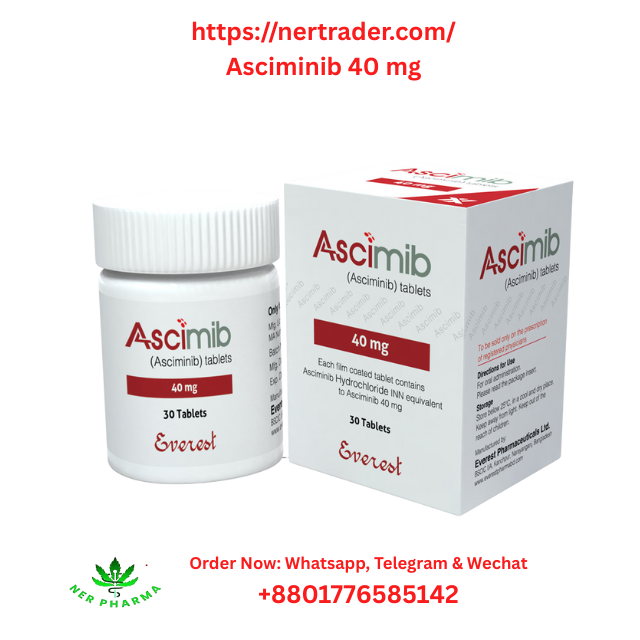
Ascimib 40 mg tablets containing the active drug asciminib are a significant advancement in the treatment of Philadelphia chromosome-positive chronic myeloid leukemia (Ph+ CML) in chronic phase (CP). Marketed under various brand names, including Scemblix, this oral medication belongs to a new category of drugs known as STAMP (Specifically Targeting the ABL Myristoyl Pocket) inhibitors. Unlike other tyrosine kinase inhibitors (TKIs) that fill the ATP-binding pocket of the BCR-ABL1 protein, asciminib binds to the allosteric myristoyl pocket, which has a distinct mechanism of action and profile of efficacy.
Therapeutic Indication and Mechanism of Action
Asciminib is indicated most prominently for adult patients with Ph+ CML in chronic phase. Asciminib is indicated for the treatment of patients previously treated with two or more TKIs, for intolerance or resistance to the previous drugs. Asciminib is also especially indicated for Ph+ CML in CP with the T315I mutation, an extremely difficult-to-treat mutation that confers resistance to most other TKIs.
Pathologic foundation of Ph+ CML is the Philadelphia chromosome, the result of which is the formation of the BCR-ABL1 fusion protein. The resultant abnormal protein acts as a constitutively active tyrosine kinase, and it results in the growth of myeloid cells in an uncontrolled fashion. Traditional TKIs primarily work by inhibiting BCR-ABL1 competitively by binding ATP to the active site. Asciminib's unique mechanism of being a STAMP inhibitor differentiates it. It binds to the myristoyl pocket of the ABL1 kinase, inducing a conformational change that keeps the BCR-ABL1 protein in an inactive state. Allosteric inhibition is crucial in that it allows asciminib to evade some resistance mutations, such as the T315I mutation, that affect the ATP-binding site. This differential approach offers a new therapeutic option for patients who have previously received other TKI treatments.
Dosage and Administration
Ascimib 40 mg tablets orally. The CP treatment dose of Ph+ CML in patients with prior treatment with two or more TKIs is 80 mg daily or 40 mg twice a day, approximately 12 hours apart. The treatment dose in T315I mutation-positive patients is typically higher, i.e., 200 mg twice a day, approximately 12 hours apart. It should be taken on an empty stomach with food intake withheld for at least 1 hour before and 2 hours after the dose administration. The tablets should be swallowed whole without chewing, crushing, or breaking. Asciminib is generally continued so long as there is clinical benefit or until unacceptable toxicity is reached. Dose adjustments are necessary based on patient tolerance and response, particularly in the management of side effects such as myelosuppression, pancreatic toxicity, and hypertension.
Pharmacokinetics
Asciminib possesses good oral bioavailability with an absolute bioavailability of approximately 73%. Its exposure can be reduced markedly by food, specifically by high-fat food, which highlights the need for its administration in fasting status. The drug exhibits more than dose-proportional increase in exposure to a minimal extent. It has a relatively limited volume of distribution (111 L) and is highly bound to human plasma proteins (97.3%). Asciminib is metabolized primarily through CYP3A4, but UGT2B7 and UGT2B17 glucuronidation also contribute. Biliary excretion via breast cancer resistance protein (BCRP) contributes to clearance also. The apparent terminal elimination half-life is approximately 8-12 hours. Renal and hepatic impairment, in addition to other factors like age, gender, and race, do not have any significant impact on the pharmacokinetics of asciminib.
Safety Profile and Adverse Reactions
While asciminib offers a new and efficient therapeutic approach, it is associated with a range of potential side effects. Some common adverse reactions reported in clinical trials are:
Hematologic: Myelosuppression, including thrombocytopenia (low platelet count), neutropenia (low neutrophil count), and anemia. Complete blood counts are to be checked on a regular basis.
Gastrointestinal: Diarrhea, nausea, and abdominal pain.
Musculoskeletal: Arthralgia (joint pain), musculoskeletal pain, and muscle stiffness.
Other: Upper respiratory infection, rash, fatigue, and headache.
Adverse reactions that occur less often but might be severe include
Pancreatic Toxicity: Elevation of serum amylase and lipase, with pancreatitis having been observed in some instances. Careful monitoring of pancreatic enzymes is to be done.
Hypertension: The blood pressure could rise, requiring monitoring of blood pressure regularly and treatment.
Cardiovascular Toxicity: Including ischemic cardiac and CNS events, arterial thrombotic and embolic disease, and cardiac failure. Patients with a well-established cardiovascular risk factor should be carefully observed.
Hypersensitivity Reactions: Ranging from rash and edema to bronchospasm.
Embryo-Fetal Toxicity: Based on animal data and mechanism of action, asciminib is capable of causing fetal harm. Therefore, it is contraindicated in pregnant women, and contraception should be used effectively in reproductive potential females for and after treatment.
Drug Interactions
Asciminib is a CYP3A4 inhibitor, CYP2C9 inhibitor, and P-glycoprotein (P-gp) inhibitor and a CYP3A4 substrate. Therefore, co-administration with strong CYP3A4 inhibitors (e.g., some antivirals, antifungals) could increase asciminib exposure and risk of adverse effects. Conversely, co-administration with strong CYP3A4 inducers (e.g., rifampin, St. John's Wort) can decrease the effectiveness of asciminib. Asciminib can also increase the plasma levels of sensitive CYP3A4, CYP2C9, and P-gp substrates, leading to potentiated toxicity of these co-administered drugs (e.g., warfarin, certain statins). Grapefruit juice should be avoided as it possesses the ability to interact with the asciminib metabolism.
Clinical Efficacy
Clinical trials have demonstrated that asciminib is clinically effective in Ph+ CML treatment. In a Phase 3 trial (ASCEMBL) of bosutinib vs asciminib in previously treated patients with two or more prior TKIs, asciminib had greater MMR rates at 24 weeks and 96 weeks and improved tolerability with fewer treatment discontinuations due to adverse events. A further trial (ASC4FIRST) investigated asciminib versus investigator-choice TKIs in patients with newly diagnosed Ph+ CML-CP and recorded better major molecular response rates at 48 weeks. These data indicate that asciminib is likely to make a big impact on this group of patients.
Conclusion
Ascimib 40 mg tablets are one of the most important therapeutic options in Ph+ CML patients, particularly those with resistance or intolerance to prior TKI medications or T315I mutation carriers. Its mechanism of allosteric inhibition is a new mechanism of action compared to other BCR-ABL1 inhibitors, making it a useful drug in salvage therapy in challenging situations. Proper planning of its administration keeping in mind its safety profile and potential for drug interactions is crucial for effective and safe management of patients.
 Safe Payment
 7 Days Return Policy
 100% Authentic Products


 english


